
Brass Dhokra Work Bastar Oil Lamp From Chhattisgarh - Ca 1910
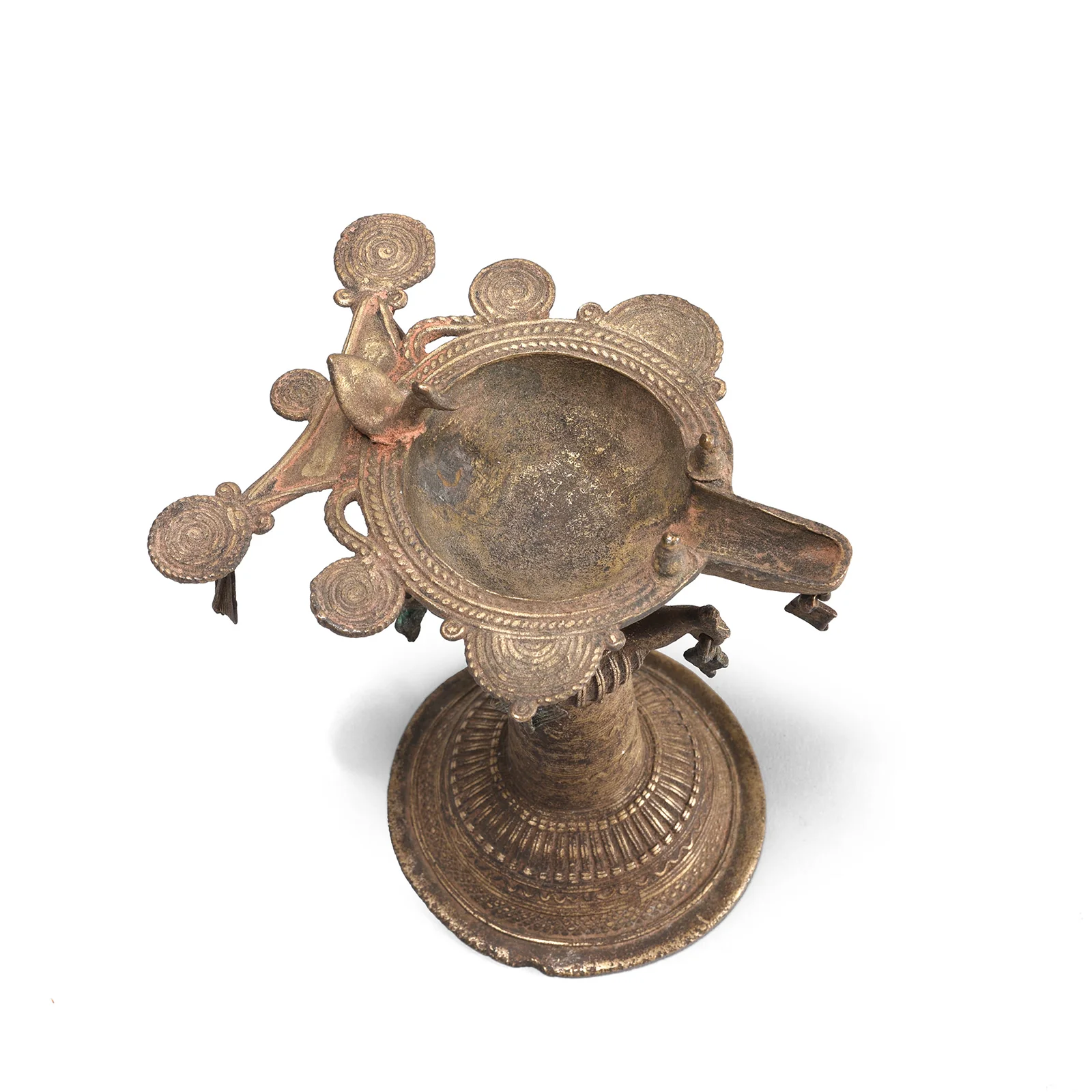
This decorative Indian brass oil lamp is from the Bastar tribes of Chhattisgarh, India. These oil lamps were used daily and would have traditionally been used with a wick and ghee oil. It dates to the early 20th century, circa 1910.
The central stand is called a stambha and is decorated with a peacock. A single peacock perches at the rim of the oil reservoir ready to drink and faces two lingams, phallic symbols of Lord Shiva. The rim is formed in the shape of a yoni, a stylized representation of female genitalia.
These oil lamps are found in both Orissa & Chhattisgarh and are made by Dokra Damar tribes, the traditional metalsmiths of West Bengal. The dhokra technique of lost wax casting is named after their tribe.
Dokra also spelled "Dhokra"- is a brass or bronze casting made using the lost wax technique. The process is commonly known as 'Cire Perdue.' The object to be cast is sculpted from beeswax mixed with a little oil. Once finished the entire figure is coated with clay made from termite hills to create the mould. The mould is dried and fired in an oven with cow-dung cakes. The wax melts leaving an empty clay mould in the shape to be cast. The mould is then heated and molten brass or bronze is poured into the empty clay mould. Once cool, the clay mould is broken exposing the cast bronze figure. The casting is then cleaned and finer details are carved to finish the piece.
Similar examples can be found on pages 81 and 91 of 'Flames of Devotion, Oil Lamps From South & South East Asia & The Himalayas' by Sean Anderson.
Dimensions:
13 x 10 x 16 (wxdxh cms)
UK Delivery Charge - except Highlands & Islands £7.50
More delivery options available at checkout
Original: $289.84
-65%$289.84
$101.44More Images


Brass Dhokra Work Bastar Oil Lamp From Chhattisgarh - Ca 1910
This decorative Indian brass oil lamp is from the Bastar tribes of Chhattisgarh, India. These oil lamps were used daily and would have traditionally been used with a wick and ghee oil. It dates to the early 20th century, circa 1910.
The central stand is called a stambha and is decorated with a peacock. A single peacock perches at the rim of the oil reservoir ready to drink and faces two lingams, phallic symbols of Lord Shiva. The rim is formed in the shape of a yoni, a stylized representation of female genitalia.
These oil lamps are found in both Orissa & Chhattisgarh and are made by Dokra Damar tribes, the traditional metalsmiths of West Bengal. The dhokra technique of lost wax casting is named after their tribe.
Dokra also spelled "Dhokra"- is a brass or bronze casting made using the lost wax technique. The process is commonly known as 'Cire Perdue.' The object to be cast is sculpted from beeswax mixed with a little oil. Once finished the entire figure is coated with clay made from termite hills to create the mould. The mould is dried and fired in an oven with cow-dung cakes. The wax melts leaving an empty clay mould in the shape to be cast. The mould is then heated and molten brass or bronze is poured into the empty clay mould. Once cool, the clay mould is broken exposing the cast bronze figure. The casting is then cleaned and finer details are carved to finish the piece.
Similar examples can be found on pages 81 and 91 of 'Flames of Devotion, Oil Lamps From South & South East Asia & The Himalayas' by Sean Anderson.
Dimensions:
13 x 10 x 16 (wxdxh cms)
UK Delivery Charge - except Highlands & Islands £7.50
More delivery options available at checkout
Product Information
Product Information
Shipping & Returns
Shipping & Returns
Description
This decorative Indian brass oil lamp is from the Bastar tribes of Chhattisgarh, India. These oil lamps were used daily and would have traditionally been used with a wick and ghee oil. It dates to the early 20th century, circa 1910.
The central stand is called a stambha and is decorated with a peacock. A single peacock perches at the rim of the oil reservoir ready to drink and faces two lingams, phallic symbols of Lord Shiva. The rim is formed in the shape of a yoni, a stylized representation of female genitalia.
These oil lamps are found in both Orissa & Chhattisgarh and are made by Dokra Damar tribes, the traditional metalsmiths of West Bengal. The dhokra technique of lost wax casting is named after their tribe.
Dokra also spelled "Dhokra"- is a brass or bronze casting made using the lost wax technique. The process is commonly known as 'Cire Perdue.' The object to be cast is sculpted from beeswax mixed with a little oil. Once finished the entire figure is coated with clay made from termite hills to create the mould. The mould is dried and fired in an oven with cow-dung cakes. The wax melts leaving an empty clay mould in the shape to be cast. The mould is then heated and molten brass or bronze is poured into the empty clay mould. Once cool, the clay mould is broken exposing the cast bronze figure. The casting is then cleaned and finer details are carved to finish the piece.
Similar examples can be found on pages 81 and 91 of 'Flames of Devotion, Oil Lamps From South & South East Asia & The Himalayas' by Sean Anderson.
Dimensions:
13 x 10 x 16 (wxdxh cms)
UK Delivery Charge - except Highlands & Islands £7.50
More delivery options available at checkout